📗 English
Ahura Mazda in Ancient Iranian Culture
Introduction
In the history and culture of ancient Iran, one of the most important concepts is the belief in a single god named Ahura Mazda. This concept was formed in the religion of Zoroastrianism and has played a very important role in shaping the thoughts and ethics of Iranians. In this article, we will become familiar with Ahura Mazda, his story, history, and related symbols in simple language.
Who is Ahura Mazda?
Ahura Mazda means “Wise Lord” or “God of Wisdom.” In Zoroastrian beliefs, he is the creator of the world and all beings. Ahura Mazda is the symbol of light, truth, wisdom, and order in the universe and holds the highest position.
The Story of Ahura Mazda
In Iranian mythology, the world is a place of conflict between the forces of good and evil.
Ahura Mazda represents goodness and light, and in contrast to him stands Ahriman, who symbolizes darkness and evil.
Ahura Mazda created the world for the victory of good over evil. He carried out creation in several stages:
- sky
- water
- earth
- plants
- animals
- humans
In this process, humans have an important role, because they must choose between good and evil.
History of Ahura Mazda
The name Ahura Mazda can be seen in the inscriptions of the Achaemenid Empire period. For example, Darius I referred to Ahura Mazda as the great god in his inscriptions.
During the Sasanian Empire period as well, Zoroastrianism was the official religion, and Ahura Mazda held a very important position.
Symbol of Ahura Mazda
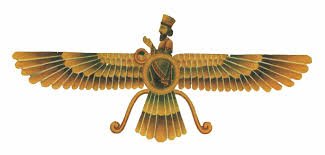
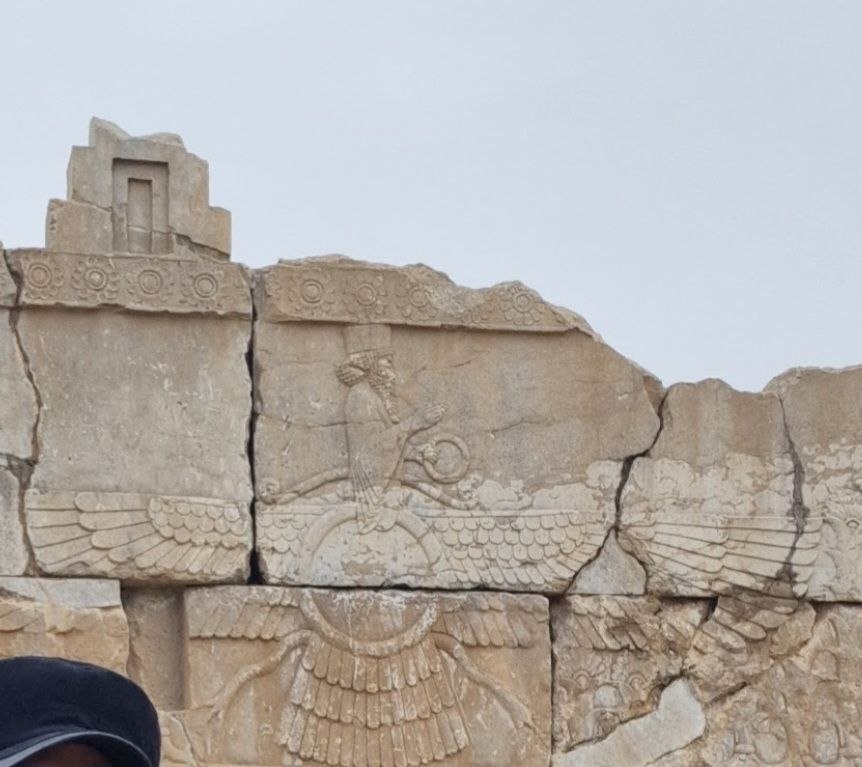
The most important symbol associated with Ahura Mazda is the Faravahar.
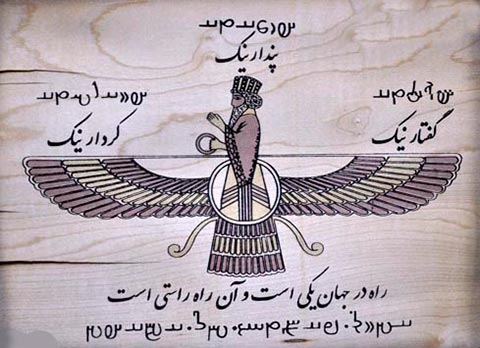
The Faravahar is usually depicted as a winged human figure, and each part of it has a specific meaning:
- Wings: symbol of good thoughts, good words, and good deeds
- Ring in hand: a sign of loyalty and commitment
- Human figure: representing the human soul and the path of growth
This symbol reminds us that we should choose the right path in life.
👴 The Face of the Old Man
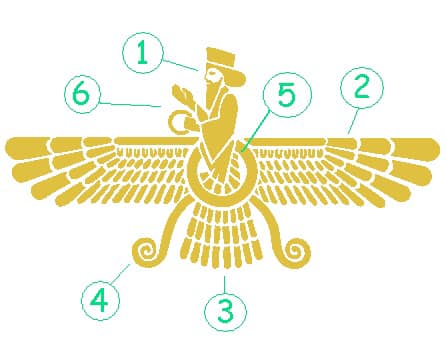
The face of an old man is in the center of the symbol. It represents a wise, experienced, and righteous person. Others learn from his behavior and experiences. So the face symbolizes wisdom and experience.
✋ The Right Hand of the Old Man
The right hand is raised toward the sky. This represents that humans should worship Ahura Mazda and follow the path of the one God. It shows that belief in a single God has been important in Iran for thousands of years.
💍 The Ring in the Left Hand
The left hand holds a ring. This ring symbolizes covenant and loyalty. Humans make a promise to God to always follow the right path. Historians also believe that wedding rings come from this tradition.
🪽 The Wings of the Faravahar
The wings on both sides symbolize progress and advancement. Humans must always strive to improve and move toward perfection.
🪶 Three Rows of Feathers on the Wings
Each wing has three rows of feathers. These represent the three principles of Zoroaster:
- Good Thoughts
- Good Words
- Good Deeds
These are the main guide for a proper life.
⭕ The Ring Around the Waist
A large ring around the waist represents the cycle of life and the universe. Humans are part of this cycle and should choose a good path in life.
🔀 Two Hanging Strips
Two ribbons hang down:
- Right: Good (Spenta Mainyu)
- Left: Evil (Angra Mainyu / Ahriman)
Humans stand between these two forces and must make the right choice.
🪶 The Tail (Bottom Part)
The tail also has three sections representing:
- Bad Thoughts
- Bad Words
- Bad Deeds
These are what humans should avoid.
Conclusion
Ahura Mazda is one of the most important concepts in ancient Iranian culture. He is the symbol of wisdom, truth, and goodness, and invites humans to choose the right path. Understanding this concept helps us better understand the history, culture, and Persian language.
📙 Finglish
Ahura Mazda dar farhang-e Iran bastan
Moghadame
Dar tarikhe va farhang-e Iran bastan, yeki az mohem-tarin mafahim, bavar be khodaye yegane be name Ahura Mazda ast. In mafhoom dar dine Zartoshti shekl gerefte va naghsh-e besyar mohemi dar shekl-giri-ye andishe va akhlagh-e Iraniyan dashte ast. Dar in maghale, ba zabani sade ba Ahura Mazda, dastan-e oo, tarikche va namadhaye marboot ashna mishavim.
Ahura Mazda kist?
Ahura Mazda be maniye “Sarvar-e Dana” ya “Khodaye Kheradmand” ast. Dar bavarhaye Zartoshti, oo khaleghe jahan va hame mojoodat ast. Ahura Mazda namade noor, rasti, danayi va nazm dar jahan ast va dar bala-tarin jayeghah gharar darad.
Dastan-e Ahura Mazda
Dar osturehaye Irani, jahan mahal-e nabard beyn niroo-haye kheyr va shar ast.
Ahura Mazda namayande-ye khubi va roshanaei ast va dar moghabel-e oo Ahriman gharar darad ke namade tariki va badi ast.
Ahura Mazda jahan ra baraye piruzi-ye kheyr bar shar afarid. Oo afarinesh ra dar chand marhale anjam dad:
- aseman
- ab
- zamin
- giyahan
- heyvanat
- ensan
Dar in miyan, ensan naghsh-e mohemi darad, zira bayad beyn khubi va badi entekhab konad.
Tarikche-ye Ahura Mazda
Nam-e Ahura Mazda dar neveshteha va katibehaye dore-ye Hakhamaneshian dide mishavad. Baraye mesal, Dariush Aval dar katibehaye khod az Ahura Mazda be onvane khodaye bozorg yad karde ast.
Dar dore-ye Sasanian niz din-e Zartoshti rasmi bood va Ahura Mazda jayeghahe besyar mohemi dasht.
Namad-e Ahura Mazda
Mohem-tarin namad-e marboot be Ahura Mazda, Faravahar ast.
Faravahar mamoolan be shekle yek ensan-e baldar neshan dade mishavad va har bakhsh az an mani-ye khasi darad:
- balha: namade andishe-ye nik, goftar-e nik va kerdar-e nik
- halghe dar dast: neshane-ye vafadari va peyman
- shekle ensan: neshan dahande-ye rooh-e ensan va masir-e roshd
In namad be ma yadavar mishavad ke bayad dar zendegi rah-e dorost ra entekhab konim.
👴 Chehre-ye Pirmard
Dar markaz-e neshan, chehre-ye yek pirmard ast. In chehre neshan-dehande-ye ensan-e danā, ba tajrobe va nikookar ast. Digaran az raftār va tajrobe-ye oo yad migirand. Pas in chehre namade kherad va tajrobe ast.
✋ Dast-e Rast
Dast-e rast be samte aseman bala rafte ast. In eshare be in ast ke ensan bayad Ahura Mazda ra parastesh konad va rah-e khod ra bar asas khodaye yegane entekhab konad.
💍 Halghe dar Dast-e Chap
Dast-e chap yek halghe darad. In halghe namade peyman va vafadari ast. Ensan ba Khoda peyman mibandad ke hamishe rah-e dorost ra entekhab konad. Gofte mishavad halghe-ye ezdevaj ham az in raah gerefte shode ast.
🪽 Balha
Balha dar do taraf neshan-dehande-ye pishraft va tarraqqi hastand. Ensan bayad hamishe talash konad behtar shavad va be samte kamal beravad.
🪶 Se Radif Par rooye Balha
Har bal se radif par darad ke eshare be se ghovvat dar amoozehaye Zartosht ast:
- Pendar-e nik
- Goftar-e nik
- Kerdar-e nik
In se ghovvat rahnamaye zendegi dorost ast.
⭕ Halghe dor-e Kamar
Yek halghe bozorg dor-e kamar ast ke neshan-dehande-ye dair-e zendegi va jahan ast. Ensan dar in charkh-e zendegi gharar darad va bayad rah-e dorost ra entekhab konad.
🔀 Do Reshte-ye Avizan
Do reshte az halghe be paeen keshide shode:
- Rast: Kheyr
- Chap: Shar
Ensan beyn in do niru gharar darad va bayad entekhab dorost konad.
🪶 Dom (Paein)
Ghesmat-e paeen ham se bakhsh darad:
- Pendar-e bad
- Goftar-e bad
- Kerdar-e bad
Inha chizhai hastand ke ensan bayad az anha khoddari konad
Natije-giri
Ahura Mazda yeki az mohem-tarin mafahim dar farhang-e Iran bastan ast. Oo namade kherad, rasti va khubi ast va ensanha ra be entekhab-e rah-e dorost daavat mikonad. Shenakht-e in mafhoom be ma komak mikonad ta tarikh, farhang va zaban-e farsi ra behtar dark konim.
📗Persian
اهورامزدا در فرهنگ ایران باستان
مقدمه
در تاریخ و فرهنگ ایران باستان، یکی از مهمترین مفاهیم، باور به خدای یگانهای به نام اهورامزدا است. این مفهوم در دین زرتشتی شکل گرفته و نقش بسیار مهمی در شکلگیری اندیشه و اخلاق ایرانیان داشته است. در این مقاله، با زبانی ساده با اهورامزدا، داستان او، تاریخچه و نمادهای مرتبط آشنا میشویم.
اهورامزدا کیست؟
اهورامزدا به معنی «سرور دانا» یا «خدای خردمند» است. در باورهای زرتشتی، او خالق جهان و همه موجودات است. اهورامزدا نماد نور، راستی، دانایی و نظم در جهان است و در بالاترین جایگاه قرار دارد.
داستان اهورامزدا
در اسطورههای ایرانی، جهان محل نبرد میان نیروهای خیر و شر است.
اهورامزدا نماینده خوبی و روشنایی است و در مقابل او، اهریمن قرار دارد که نماد تاریکی و بدی است.
اهورامزدا جهان را برای پیروزی خیر بر شر آفرید. او آفرینش را در چند مرحله انجام داد:
- آسمان
- آب
- زمین
- گیاهان
- حیوانات
- انسان
در این میان، انسان نقش مهمی دارد، زیرا باید بین خوبی و بدی انتخاب کند.
تاریخچه اهورامزدا
نام اهورامزدا در نوشتهها و کتیبههای دوران هخامنشیان دیده میشود. برای مثال، داریوش اول در کتیبههای خود از اهورامزدا به عنوان خدای بزرگ یاد کرده است.
در دوره ساسانیان نیز دین زرتشتی دین رسمی بود و اهورامزدا جایگاه بسیار مهمی داشت.
نماد اهورامزدا
مهمترین نماد مرتبط با اهورامزدا، فروهر است.
فروهر معمولاً به شکل یک انسان بالدار نشان داده میشود و هر بخش آن معنی خاصی دارد:
- بالها: نماد اندیشه نیک، گفتار نیک و کردار نیک
- حلقه در دست: نشانه وفاداری و پیمان
- شکل انسان: نشاندهنده روح انسان و مسیر رشد
این نماد به ما یادآوری میکند که باید در زندگی راه درست را انتخاب کنیم.
🪶 مفهوم نشان فروهر
نکته جالب درباره نشان فروهر این است که هر بخش آن معنی خاصی دارد و پر از مفهوم و دانایی است. در ادامه، قسمتهای مختلف آن را ساده توضیح میدهیم:
👴 چهره پیرمرد
در وسط این نماد، چهره یک پیرمرد دیده میشود. این پیرمرد نشاندهنده یک انسان دانا، باتجربه و نیکوکار است. او کسی است که دیگران از رفتار و تجربهاش یاد میگیرند. به همین دلیل، این چهره نماد خرد و تجربه است.
✋ دست راست پیرمرد
دست راست به سمت آسمان بالا رفته است. این حرکت یعنی انسان باید به سوی اهورامزدا توجه کند و او را ستایش کند. این نشان میدهد که باور به خدای یگانه از گذشتههای بسیار دور در میان ایرانیان وجود داشته است.
💍 حلقه در دست چپ
در دست چپ پیرمرد یک حلقه وجود دارد. این حلقه نماد پیمان و وفاداری است. یعنی انسان با خدا عهد میبندد که راه درست را انتخاب کند. گفته میشود حلقه ازدواج هم از همین مفهوم گرفته شده است.
🪽 بالهای فروهر
بالهایی که در دو طرف دیده میشوند، نشاندهنده حرکت و پیشرفت انسان هستند. یعنی انسان باید همیشه تلاش کند بهتر شود و به سوی کمال حرکت کند.
🪶 سه ردیف پر روی بالها
روی هر بال سه ردیف پر وجود دارد. این سه بخش نماد سه اصل مهم در آموزههای زرتشت هستند:
- پندار نیک
- گفتار نیک
- کردار نیک
این سه اصل، راهنمای زندگی درست انسان هستند.
⭕ حلقه دور کمر
یک حلقه بزرگ دور کمر پیرمرد قرار دارد. این حلقه نشاندهنده چرخه زندگی و جهان است. یعنی انسان در این دنیا قرار دارد و باید راه درست زندگی را انتخاب کند.
🔀 دو رشته آویزان
دو رشته از حلقه به سمت پایین کشیده شدهاند:
- سمت راست: نماد خوبی
- سمت چپ: نماد بدی
این یعنی انسان همیشه بین خیر و شر قرار دارد و باید انتخاب کند.
🪶 دم (پایین نماد)
قسمت پایین نماد هم سه بخش دارد که نشاندهنده:
- پندار بد
- گفتار بد
- کردار بد
است. یعنی چیزهایی که انسان باید از آنها دوری کند.
نتیجهگیری
اهورامزدا یکی از مهمترین مفاهیم در فرهنگ ایران باستان است. او نماد خرد، راستی و خوبی است و انسانها را به انتخاب راه درست دعوت میکند. شناخت این مفهوم به ما کمک میکند تا تاریخ، فرهنگ و زبان فارسی را بهتر درک کنیم.
📊 Important Vocabulary
| فارسی / Finglish | English |
|---|---|
| اهورامزدا / Ahura Mazda | Ahura Mazda |
| اهریمن / Ahriman | Ahriman (evil spirit) |
| فروهر / Faravahar | Faravahar |
| فرهنگ / farhang | culture |
| ایران باستان / Iran-e bastan | ancient Iran |
| تاریخ / tarikh | history |
| باور / bavar | belief |
| خدای یگانه / khodaye yegane | one God |
| دین / din | religion |
| زرتشتی / Zartoshti | Zoroastrian |
| اندیشه / andishe | thought |
| اخلاق / akhlagh | ethics |
| خرد / kherad | wisdom |
| خالق / khalegh | creator |
| جهان / jahan | world |
| موجودات / mojoodat | beings |
| نور / noor | light |
| راستی / rasti | truth |
| دانایی / danayi | knowledge |
| نظم / nazm | order |
| اسطوره / osture | mythology |
| نبرد / nabard | battle |
| خیر / kheyr | good |
| شر / shar | evil |
| روشنایی / roshanaei | brightness |
| تاریکی / tariki | darkness |
| آفرینش / afarinesh | creation |
| آسمان / aseman | sky |
| زمین / zamin | earth |
| گیاهان / giyahan | plants |
| حیوانات / heyvanat | animals |
| انسان / ensan | human |
| انتخاب / entekhab | choice |
| کتیبه / katibeh | inscription |
| نماد / namad | symbol |
| وفاداری / vafadari | loyalty |
| پیمان / peyman | promise |
| روح / rooh | soul |
| رشد / roshd | growth |
| پندار نیک / pendar-e nik | good thoughts |
| گفتار نیک / goftar-e nik | good words |
| کردار نیک / kerdar-e nik | good deeds |
| خردمند / kheradmand | wise |
| تجربه / tajrobe | experience |
| پیشرفت / pishraft | progress |
| کمال / kamal | perfection |